
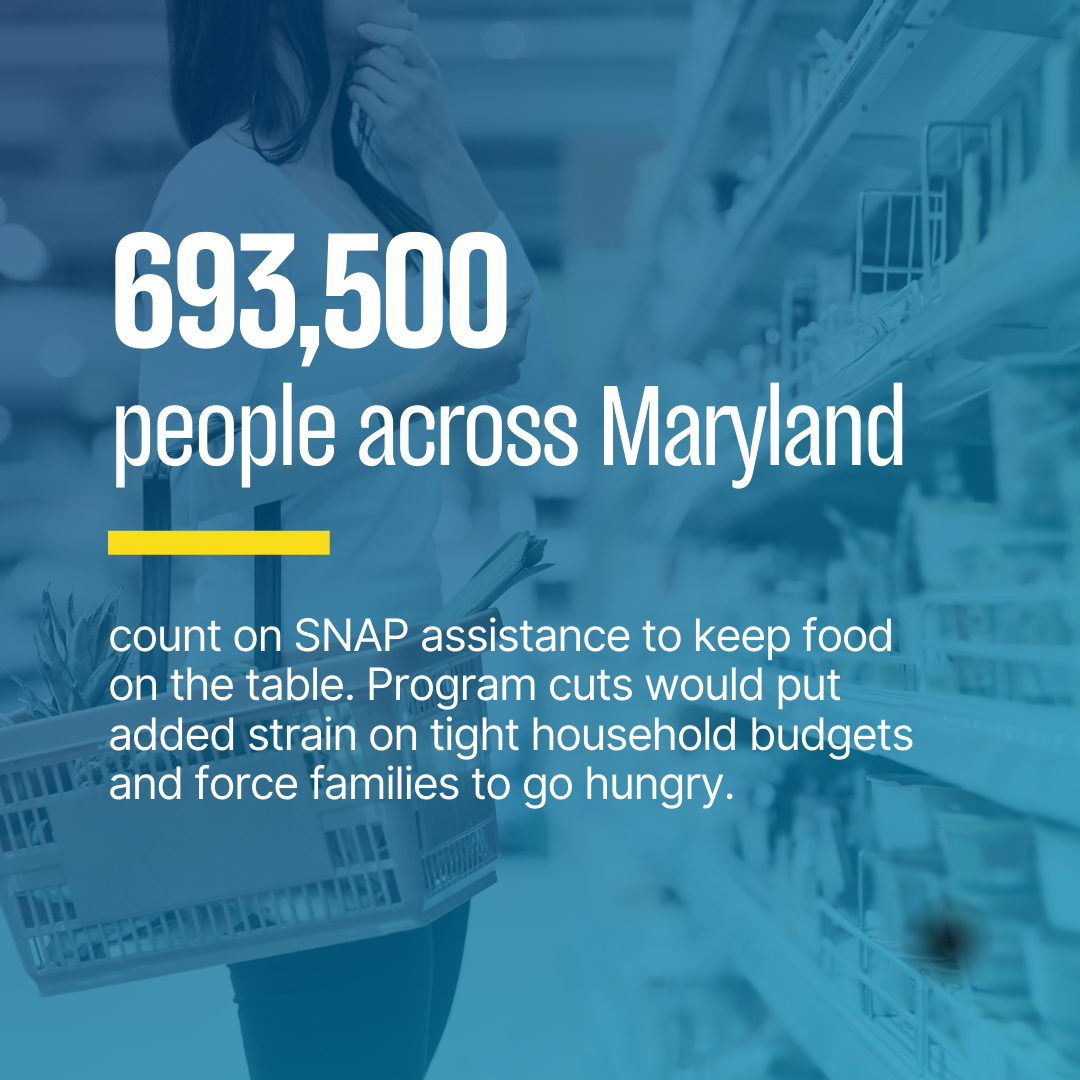
 There are more than 300,000 households in Maryland that depend on the Supplemental Nutrition Assistance Program (SNAP) to put food on the table, but its future appears to be at risk. The House budget resolution proposes slashing a 20 percent reduction in total funding for food assistance that would be the largest cut in SNAP’s history. At a period of high inflation, tariffs and economic uncertainty, these proposed cuts could not have come at a worse time.
SNAP helps 1 in 9 Marylanders, about 11% of the state’s population, afford enough to eat with children, older adults and people with disabilities particularly benefitting from this vital program. As of 2022, in Maryland it provided food assistance to 216,000 children, 93,000 people over the age of 60, 64,000 people with disabilities under the age of 60 and 63,000 age 18-49. In addition to increasing food security for vulnerable populations, it also supports public health, lowers health care costs, reduces poverty and stimulates local economies, resulting in more than $1.9 billion spent on groceries at more than 3,800 Maryland food retailers in 2023. Yet, despite SNAP’s proven effectiveness, the recent budget resolution passed by the U.S. House of Representatives calls for Congress to cut $230 billion over a decade in the committee that oversees SNAP.
Currently there are four proposals under consideration, all of which would take grocery money away from thousands of Marylanders and our communities across the state. While Congressional leaders claim they won’t cut food benefits directly, the four policies under consideration end eligibility for certain groups or would fundamentally change the structure of the program, ultimately resulting in cuts.
Shift funding obligation for SNAP to states
Since SNAP was created, all benefits have been fully funded by the federal government with nearly 94% of that funding going directly to food. One of the proposals for SNAP cuts would require states to cover some of the cost, which would result in states either having to come up with the funds for this new obligation, cut SNAP spending, or create barriers to participation in order to lower costs.
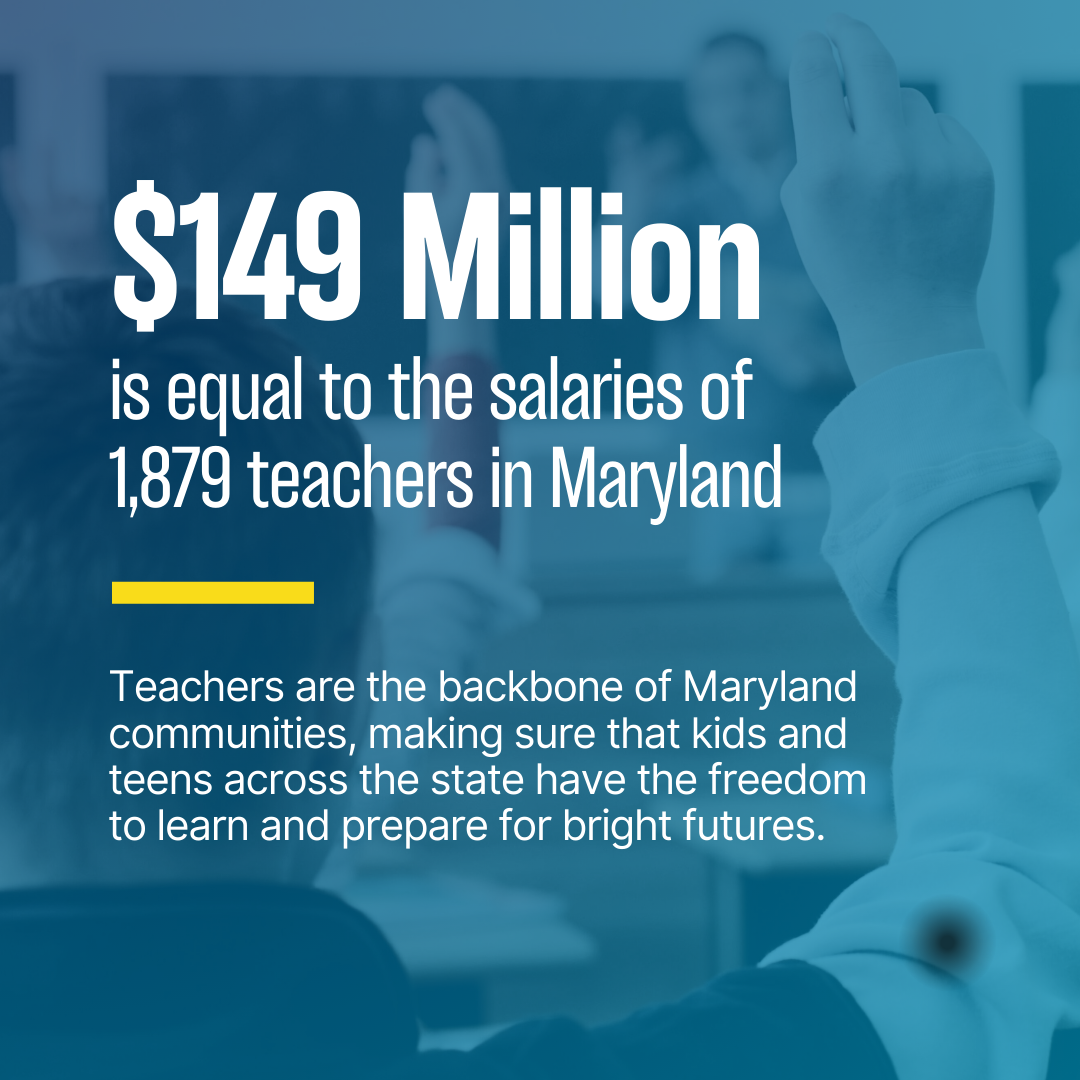 For example, covering just 10% of the cost of SNAP in fiscal year 2026 would cost Maryland almost $149 million. That would be the equivalent of salary costs for 1,876 teachers in the state. Requiring the state to cover 25% of the cost of SNAP would be even higher at $373 million, the equivalent of salary cost for 4,697 teachers. At a time when Maryland just closed a $3 billion budget deficit to balance the next year’s budget, this would put additional strain on the budget and would likely force the state to reduce benefits, restrict eligibility, or both in other to offset the increased cost. This would likely lead to more Marylanders unable to afford enough to eat. It would hurt our local economies and would disproportionately affect low-income Marylanders, especially seniors, children and people with disabilities.
Requiring state funding would also eliminate the anti-recession effect of SNAP during a downturn. SNAP is currently structured to quickly meet the increased need for food assistance and bring economic relief during tough economic times, when state revenues are often also decreasing. In a downturn, every dollar of SNAP spending results in $1.50 in economic activity starting with grocery stores and farmers but ultimately stimulating entire local economies.
Expanding work requirements and time limits
Currently, SNAP participants between ages of 18 and 54 who do not have children in the home or a documented disability are required to report at least 20 hours of work per week or prove they are exempt (for instance, if they are unhoused or a veteran). Without being able to document steady work, these participants can only receive three months of food assistance.
One proposal by Representative Dusty Johnson would extend the work requirements that now apply to people classified as “able bodied adults without dependents” to parents who have children ages 7–17 and older adults up to age 65. These changes disregard the fact that a majority of people who rely on public benefits already work, have disabilities, or serve as full-time caregivers. Increasing work requirements exacerbates poverty without addressing its root causes. Instead this proposal is more likely to take food away from millions of people in low-income households who are struggling to find steady work or who face substantial barriers to employment, including families with children. It would harm not only the adults subject to the requirement, but also the people they live with, including children and people with disabilities, by reducing food benefits for the entire household. Estimates indicate that in Maryland a monthly average of 26,000 SNAP recipients ages 55-64 with no children or disability and 45,000 ages 18-64 with school aged children and no disability will be at risk of losing their SNAP benefit, if you include those in households the numbers increased to 29,000 and 100,000 respectively. Research has consistently shown that SNAP’s current work requirement does not increase employment or earnings, and there is no reason to think expanding it would produce different results.
The Johnson proposal would dramatically expand SNAP’s punitive and ineffective three-month time limit to find a job by applying it to additional groups of people and essentially eliminating states’ longstanding ability to temporarily waive the time limit in areas with higher unemployment or insufficient jobs. This would impact older adults up to age 65, families with children who are seven years of age or older and several groups that are currently exempt, including the 21,000 veterans who receive food assistance in Maryland, people experiencing homelessness and youth aging out of foster care.
Restricting what SNAP recipients can purchase
Recently, Congress and several states, have seen proposals to restrict what people can purchase with SNAP benefits. Despite the evidence that SNAP and non-SNAP households have similar shopping patterns, these restrictions create barriers to people with SNAP without improving the availability of affordable healthy options. Such restrictions are unworkable for retailers who may decide it is easier to no longer accept SNAP, reducing all food options for SNAP participants. Additionally, these restrictions create costly red tape for state agencies who would be responsible for defining which of the thousands of new foods each year qualify and enforce these regulations with retailers.
Restricting food choices is about policing people experiencing poverty, not improving public health. These restrictions contradict the very purpose of SNAP, cutting benefits while simultaneously limiting food options would only deepens food insecurity.
Reversing the 2021 Thrifty Food Plan Update and Freezing Future Adjustments
A proposal by the House Agriculture Committee Chair Glenn Thompson would reportedly freeze the value of the Thrifty Food Plan (TFP), the basis for SNAP benefits, outside of inflation adjustments. This proposal would limit the Department of Agriculture’s (USDA) authority to adjust the cost of the TFP to accurately reflect the cost of a frugal, healthy diet. USDA would be required to regularly undertake a rigorous and resource-intensive evaluation that would only ever result in a single pre-determined outcome: the cost of a healthy diet would remain unchanged, regardless of scientific evidence to the contrary.
According to Thompson, the Congressional Budget Office (CBO) estimates this would result in a roughly $30 billion SNAP cut over the next decade, a cut that would affect every SNAP participant. The cuts are expected to grow larger in the long term and, as a consequence, SNAP benefits would become less adequate over time. CBO estimates put cuts to Maryland’s SNAP benefits, as a result of the plan to restrict TFP updates, at $450 million from Fiscal year 2027 – 2033.
Thompson’s proposal would return SNAP to the situation in place before 2021, when the cost of the TFP was adjusted only for inflation, resulting in SNAP benefits becoming increasingly inadequate over time. USDA had to assume that people purchased an extremely unrealistic set of foods in order to claim that SNAP benefits were nutritionally adequate.
The proposed SNAP cuts are harmful because they threaten the wellbeing of millions of low-income individuals and families who rely on this vital program for food security. These cuts would disproportionately impact children, seniors and people with disabilities exacerbating hunger and poverty across the state and country. Furthermore, reducing SNAP benefits could strain local economies and increase long-term costs in healthcare and social services. Rather than weakening a program that has proven its effectiveness over the years, efforts should be made to strengthen it.