
Maryland’s children and families have seen areas of significant economic progress and lingering educational challenges since 2019, the year prior to the start of the pandemic, both of which underscores the effectiveness of state and federal policies as well as the need for continued investments in education. The 2025 KIDS COUNT Data Book®, a 50-state report of recent data developed by Annie E. Casey Foundation analyzing how kids are faring in post-pandemic America, finds that Maryland is ranked 21st in overall child well-being.
Each year, the Data Book presents national and state data from 16 indicators in four domains —economic well-being, education, health, and family and community factors — and ranks the states according to how children are faring overall. The data in this year’s report are mostly from 2023. New Hampshire, Vermont and Massachusetts rank first, second and third in overall well-being in the 2025 Data Book; Mississippi, Louisiana, and New Mexico ranked 48th, 49th and 50th, respectively. The report this year, which focuses on how children and families have fared since 2019, finds that in Maryland eight of the 16 key indicators have improved, six have worsened and two have not changed.
Positive Trends in Economic Well-being
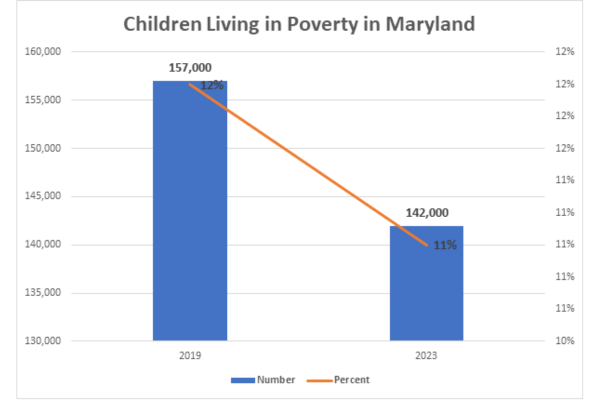
The success of state and federal policies, such as expanded working family tax credits and a higher state minimum wage, in strengthening support for those who needed it most is reflected in the economic well-being domain, which saw positive trends in all 4 key indicators. There were 15,000 fewer children living in poverty in 2023 compared to 2019, an 8 percent decrease.
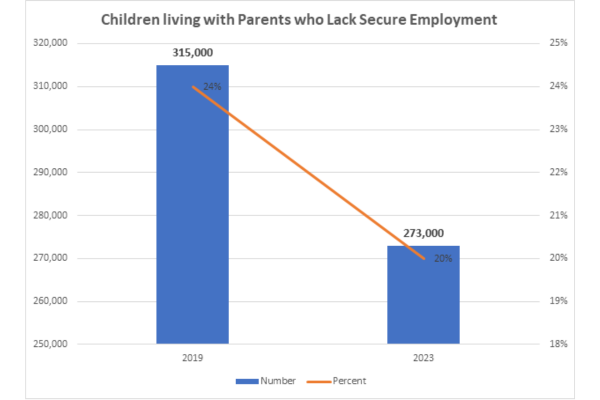
The number of children living in families were neither parent was fully employed all year around declined from 24 percent in 2019 to 20 percent in 2023, a 17 percent drop.
High housing costs remain the greatest challenge for Maryland families, as 29 percent of Maryland’s children were living in households with high housing cost burden in 2023 compared to 31% in 2019. High housing cost burden means households in which more than 30% of monthly household pretax income is spent on housing-related expenses. Despite this improvement, it is worth noting that nearly 1 in 3 Maryland children lived in households burdened by high housing costs, reflecting that significant financial pressure still remains on families and the need for continued investment in the economic wellbeing and security of families.
Setbacks in Education
A good education is key to future career success which is why it is worrying that all four indicators in the education domain have worsened since 2019. Preschool participation for children ages 3 and 4 has not yet recovered to pre-pandemic levels with an average of 54% not attending school from 2019-2023 compared to 50% from 2014-2018, an 8% increase.
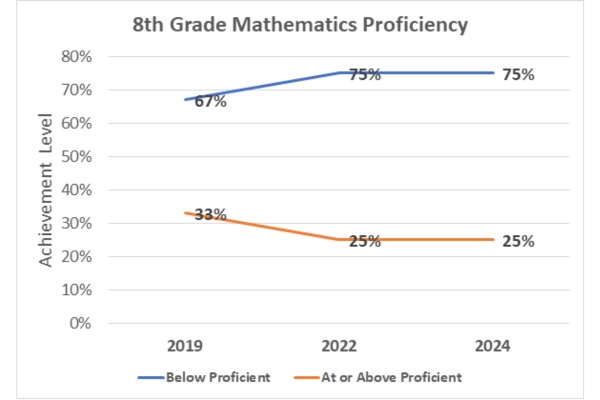
Reading and math proficiency also declined. 66% of 4th graders were not proficient in reading in 2024 compared to 65% in 2019. 75% of 8th graders were not proficient in mathematics compared to 67% in 2019, a 12% increase. At a time when STEM fields are at the heart of technological advancements and economic development, it is critical that we ensure that Maryland’s children are equipped to compete for the careers of the future. It also highlights the need for Maryland policymakers to fully fund and implement the Blueprint for Maryland’s future.
In the area of health, 95% of children in Maryland had health insurance in 2023 – a decline from 2019 when 97% of children were insured. There was also a 25% increase in child and teen deaths compared to 2019, some of which can be attributed to gun violence and drug abuse.
While the trends the Data Book documents are noteworthy, it is important to keep in mind that most of the data is from 2023 and since then a lot has happened – from federal workforce layoffs to state budget deficits as well as threats to programs that have proven effective in leading to some of the positive trends highlighted in the Data Book. All of these threaten to reverse some of the gains made in the previous years which is why it is critical that there are no cuts to SNAP, Medicaid, and other programs that low-income families rely on and that Maryland maintains its commitment to education funding and the Blueprint for Maryland’s Future. This is a time to make investments that will guarantee the economic well-being and health of families and ensure a prosperous future for children.
You can read the report and see how Maryland ranks in comparison to other states at mdeconomy.org/2025-kids-count-data-book/